What’re UGC-CARE List journals | Best UGC-CARE Journals (Group I & Group II)

What is UGC-CARE

The University Grant Commission (UGC) has established a dedicated Consortium for Academic Research and Ethics (CARE) to ensure the prevention of academic misconduct that includes plagiarism among students, faculty, researchers, and staff. UGC-CARE was formed to promote quality research work improve academic integrity and publication ethics among all Indian universities and create a UGC-CARE references journal list for all academic purposes. 


Types of UGC-CARE Journals (Group I & Group II)

All journals enlisted in the Consortium for Academic Research and Ethics (CARE) journals created by the University Grants Commission (UGC), India’s higher education governing body, are regarded as popular or high-quality journals and also called UGC-approved journals. The list is compiled by UGC according to various protocols and previously it was categorized into four groups namely Group A group B group C and Group D,

But now to simplify the process, it is reduced and was naturally divided into two groups Group I and Group II

Those journals found qualified through University UGC-CARE protocols or called UGC-CARE list group I and those journals are indexed in globally recognized databases such as Scopus and Web of Sciences databases are called UGC-CARE list Group II

The UGC-CARE list is dynamic and it will be updated every three months usually it will be updated on 1stof January 1st of April 1st of July and 1st of October months in every year.

How to find UGC-CARE journals

Let’s see how to find the UGC-CARE list of journals online, go to Google browser just type UGC-CARE list and you will get a result in which the first link UGC-CARE Pune University, just click on that official website of the University Grant Commission click on this you can see

  In this link, you will reach on University Grants Common, Consortium for Academic Research and Ethics (CARE) website, and on this website, you will get important notifications and a list of journals and everything you want to see the UGC-CARE list of journals Group I and group II, list of the cloned journal and other information. Click this UGC-CARE list and it will take you into the registration area.

To access this Group I and Group II list of journals you need to register here you have to register your credentials like you have to fill in all the particulars and give submit upon submitting it you will get that access you will get a user ID and using the password you can log in to the account.

Once you logged in now you can access the list of journals just click the UGC-CARE list and see the information about both group journals and you can search the particular journal’s information using the ISSN number and journal name you wish to search.

In Group I, you can Search the journal name in various categories registered and categorized into i) Science ii) Social Science iii) Arts and Humanities and iv) Multidisciplinary based on a database formed and maintained by Scopus Elsevier called All Science Journal Classification (ASJC).

In the case of Group II, you can search journals by following links Web of Science include Arts and Human Citation Index, Extended Science Citation Index, Social Sciences Citation Index, and Scopus database  For more about Journal in Group II

You can search journals by the title or ISSN number and for all information about the publisher, subject or language, indexing of the publication, and other information for the identity of the journal in the UGC-CARE list.

Some journals are categorized as predatory or fake journals and cloned journals. Such journals are removed from the UGC-CARE list database from time to time after receiving complaints about several journals which are not following the standards of publishing journals or not following the publication practices proper peer-review process and in this act, the UGC removed such types of journals from UGC Care list and all those journals are available on the website as List of cloned Journals Group I and Group II by clicking you can see the name of the journal

Thank you all for accepting this article, hope you better understand the UGC-CARE journal process and purpose, feel free to suggest and pen us for better upcoming important articles and if you will not miss such important type of article edition please subscribe to KRS and also help your friends by sharing this article and you can visit other sections of KRS for more academic and scientific writing articles, thank you all.

Please share and subscribe to our website, so that it can reach all people in need, and for more E-content, for research support, you can find it on our website or you can also write us at info@kressup.com for a free consultation.

How To Formulate Best Thesis Statement | Correct thesis formulate

If you are researching how to formulate the best thesis statement or the correct thesis formulation,

You are on the right track because we are here to prove to you the best solution to your question and have enlisted the 5 best thesis statement points that are enough to formulate the best thesis statement.

It is our guarantee that, after reading this article, you will be able to form the best thesis statement.

If you are having trouble in formating or writing your thesis, send us an email and our teacher will assist you. 

I have always used these steps in my training and have gotten successful results.

In this article, you will learn about the most common thesis statement mistakes that happen during the process of thesis formation by most big researchers.

Here we are giving you the idea and tips on how to avoid them. We will use some examples to explain the correct thesis formulation and how we formulate a thesis.  

By the end of this article, make sure you will know everything about the thesis statement and what you need about the thesis statement formulation. It should help you come up with the perfect thesis.

Read: How To Write Your Thesis And Well Structured Content

The best thesis statement may contain the following points

If you are using these points and forming your thesis statement, it’s guaranteed that you will make the most unique thesis ever.

Because the strategies and the steps necessitated in the below paras are formed as a result of the empirical research and suggestions by the emeritus in the field of scientific writing and analysis.

1. Presenting a Fact Instead of an Argument

Now, this is a very common mistake in a thesis statement, but you can easily avoid it. The first step you must take is to figure out what your thesis statement is.

If we take a look at the definition, then a thesis statement “is the main argument that will be explored throughout the entire article.” What is the most distinct feature of the argument?

It is arguable. It means that the reader might want to challenge your thesis. If the reader cannot do so, then that means that you’ve probably presented a fact.

Let’s look at the example of the India-China trade war. We do not see any author’s opinion here and cannot challenge this statement. It is simply true, and you will not make an essay out of it.

Finally, we know this is a statement that “trade war between two countries can impact the global economy and we see the author’s opinion, which can be challenged.”

For example, the reader might say something like, “I disagree.” The significance of this trade war will be less dire. ” Now your next task is to convince the reader that your argument is logical, viable, and, most importantly, true.

2. Presenting the thesis in the text

Often, students are not exactly sure where the thesis statement goes. In rare cases, it can be found in various segments of the paper, starting from the introduction, body, and even sometimes in the conclusion section.

So, here is the rule of thumb: in 99% of academic writing, the thesis must appear in the introduction of your paper. More specifically, the thesis should only appear as the last sentence in this section.

To make things easier, keep the following structure in mind: First, reader by presenting and proceed by briefly introducing your topic of discussion and adding any relevant background information, and finally finish off the introduction by presenting an arguable thesis statement.

So let’s look at an example. “This trade war weakens the global economy.” In this statement, there are a couple of reasons. The war suppressed international trade growth and factory output around the world.

“In this example, the introduction starts with a thesis. After that, the author immediately moves to reason.

We already know that this is bad practice, so let’s see how we can improve it. This trade war has been going on for a couple of years and has taken a toll on both countries.

Yet, the consequences of this trade war have the potential to be much direr as it can undermine the global economy. “

Here we have two sentences. The first one is introductory, and it helps the reader understand what the essay is about. The second one is the thesis, in which you present the argument you will be defending throughout the paper.

Keep in mind that it is important to add some supporting content between the hook and the thesis. This will make the flow of ideas more natural and logical.

3. Making an Uncertain Thesis Statement

Sometimes, students use expressions such as “I believe,” “I think,” and “In my humble opinion.” This is bad practice to perform, as such phrases weaken the thesis and show your uncertainty. Plus, they just take up valuable word count for no good reason.

Remember: you are the boss of your essay. So, use the words to make a solid statement and present your point throughout the essay.

For example, you are going to write a literature paper and explore whether Savitribai Phule is a feminist character. Here is a bad example: “In my opinion, Savitribai Phule is a feminist model, considering her character traits and relationships with men.” You see the problem, right?

Luckily, this thesis statement can be improved by opinion and expression. We use to analyze her character and relationships with other men which proves that she holds all the criteria for a feminist mode. Now it is clear that you are confident and know exactly what you are talking about. Can’t wait to see your reasons.

4. Making the Thesis Statement Too Broad

It may sound a bit counterintuitive, but it is much harder to come up with one excellent thesis sentence than to provide five mediocre ones. Also, you need to make sure that your statement is not too broad.

Let’s see some examples to make things a bit clearer. For example, many industries in China are using taxpayer income ineffectively. It is one sentence.

But does it make a good thesis statement? The answer is no because after reading it, we still have lots of questions. Which industries? How exactly do they use the money and why is it ineffective?

So let’s elaborate upon this statement: “In China, the agriculture industry is spending taxpayers’ money unsuccessfully by financing less talented sectors.” So, as you can see, it is still one sentence.

But we see that the author has summarised information from a broad topic and transformed it into a precise thesis statement.

Why is it so important? A clean-cut thesis statement is an indication that the author is familiar with the topic and knows what he is talking about. If you cannot present the thesis in one question, it means that you need to spend more time researching the topic.

5. Making the Thesis statement a Question

Remember, the primary goal of the thesis is to inform the reader about your position on a topic. The question can’t state anything, so using it as a thesis is completely illogical.

Let’s look at this example: “Do people need to choose more sustainable makeup brands?” There is no statement here. The reader cannot see your position on the topic. You have to focus on firm statements.

Like this one, example: “People need to choose more sustainable makeup brands to become more eco-friendly.” It is a firm statement, no questions asked. So, pay extreme attention to your thesis statement. It is not only essential for the reader, but it also helps you develop and create a fantastic piece of writing.

Think of it as an anchor, a compass, or a guiding light. It does not matter which metaphor you choose. Just remember that your thesis statement is the driving force behind the rest of your writing.

If you enjoyed the article, please leave a comment or suggestion for future topics that you would like us to discuss.

Read: Tips for Writing Your Thesis Statement

Wrapping Up

This is all about this article and hopes you understand everything about the thesis statement and are ready to compose a great thesis on any topic and formulate thesis.

KRS make sure to subscribe to our blog, as we have many more articles coming soon.

Please share and subscribe to our website, so that it can reach all people in need, and for more E-content, or research support, you can find it on our website or you can also write us at info@kressup.com for a free consultation.

If you find this article useful, don’t forget to share it!

Related Articles:

General FAQ Related to Thesis statement

Q 1. What is a thesis statement

It is a type of writing assignment that aids in organizing the ideas in the document

Q 2. Need of the thesis statement

It provides your writing with direction, concentration, and a succinct summary of your key point for the reader.

How To Write A Research Proposal | Best Structure for A Research Proposal

In this article, we will cover four questions associated with the research proposal first explain what is research proposals are second how to structure your research topic and how to plan your research proposal, and finally, how do you like a good research proposal. 

The research proposal is a declaration that gives the reader a good reason to do the white research and contains some questions that need answers to research problems or questions based on previous research or in literature now.

The basic sections in a research proposal are the title of the study introduction, the significance of the research, the literature review, methodology which includes the research design and data analysis expected results ethical statements time frame or type of plan, and budget, and finally your primary references.

What is a research proposal

A research proposal is a document proposed by a scholar before completing his/her research work. It is a summary of what you intend to research and with the broader context of the research on the subject and the importance of what you are proposing to do that you can think and read freely as well as communicate clearly. 

When you are writing a research proposal you have a list of suitable relevant literature and after writing a killer proposal you can check spelling errors in the proposal carefully during the process of editing and make it a unique first draft that the reader is attentive to the reader, what you are proposing to research. 

How do you choose a topic for the research proposal

You must choose a research topic that you are interested in researching something that you find interesting. It will be a topic that you will work with for an important time such as choosing a supervisor as long as you have a clear topic in mind.

Your topic should give the reader an idea of ​​what you are testing in other words it should clearly show your topic and put what you are doing however do not make it too long or too long it should not be more than 15 words and should catch and draw the attention of the readers.

The introduction introduces the reader to the topic in question and usually begins with a brief review of the history of the topic the introduction describes the general field of interest and shows how the topic you have chosen fits within. This section should show what you like in research. The importance of research discusses your main purpose and the importance of your study. 

There are two things you need to introduce at this point first is the purpose of the research. You should indicate what goals you are expected to achieve with your research and what specific research questions will be answered the second thing is the importance of your research you should be able to show the student why your research is important and what type of contribution you will make in the scientific field.

Significance of your research proposal 

In the significance of your study, there are two main features you should present at this point

First is the purpose, what is the purpose of your study, and the overall aim of your research this should be definite if there are any hypotheses they should also be stated. You should indicate what objectives you expect to achieve through your study and what specific research questions will be addressed

The second part of your significance is, why your research is important and what contribution will your study make to the field of awareness furthermore it is important to show what are the wider implications or uses of your study in the world of knowledge or for the scientific community.

Literature review for research proposal

This is the most important stage or section in the research proposal writing in most cases this is written as a separate chapter review book that should discuss your proposed research relationships with local and international researchers or work carried out in the related field.

The literature review focuses on what has been done in other parts of the world and discussed what major research studies have been done before and highlights how your study will fill the current knowledge gap, and explain the tools you will use in your study. why is it important to do your research and ultimately set the boundaries of your studies? 

Research design or methodology for research proposal

Research design is defined as the working model of your study and discussed in detail how you will collect data and which method you will use what tools or tools you will use to collect data or interviews, check case content analysis, etc should be clearly defined in this section this may include quantitative and qualitative studies. 

The research work you plan to do and the method chosen should be in line with your research questions and the research shows the connection between your questionnaire and the data collection tools which you will be used at the end of the study and if your research work includes discussions and evaluating in the research method section may be of the highest quality.

The conceptual framework for which you will use the data analysis should clearly state how you will present your results and discuss any scientific experiments you will use during the research.

There is one tip to work on each idea separately and state the analysis that will be done by the candidate the research section has a section that discusses what you think will be based on your intuition to explore and study.

Primary references for the research proposal

It includes a list of all sources and information cited in your proposal or the reference you can use during the preparation of your research proposal, the reference comes at the end of the proposal writing.

 For more about references, you can click on References Writing

Last, but not least provide a technical program and year-wise plan for your research work. You can change this work plan according to your research tenure. We are explaining only for 2 years.

 This is all about this article and hopes these different tips and tricks for research proposal writing help you in your scientific writing and research carrier, KRS is an online learning platform, which brings novel articles from time to time, to stay connected.

Please share and subscribe to our website, so that it can reach all people in need, and for more E-content, or research support, you can find it on our website or you can also write us at info@kressup.com for a free consultation.

 If you find this article useful, don’t forget to share it!

Related Articles:

General FAQ Related to Research Proposal

Q 1 . What research proposal

is a document proposed by a scholar before completing his/her research work?

Q 2. Significance of the research proposal

It helps the authors map out the main ideas and thoroughly explain them to the reader.

Q 3. How long is a research proposal

It’s around 2000-2400 words however there is no upper or lower bound to write a proposal.

What’s i10-index? | How to calculate i10-index for free

It is very likely that you heard the term i10-index if you are a researcher and you published a paper during your research period.

If you have not heard of this term till date and wish to know more about it, you are in right place.

In this article we will discussing in detal about i10-index and also show you how you can calculate this index for your research publication by using the methods discussed in this article.

Its our gurantee, that after reading this article in detail and carefully, I hope you will be able to assess and apply this index in you research

If you encounter any difficulty in your research you can simply email us

i10-index is the quantities matric used to assess the quality of research work published by an author in his carrier of research.

This method of citation is provided by Google scholar database and is defined as the number of papers with a minimum of 10 or more citations each or how many papers have cited a minimum of 10 times are called the i10-index.

Read: How To Conduct A Literature Review Using Google Scholar Step By Step Guide

 It is also treated as author level matric which helps to measure the efficiency of an author. For Example, if you have 7 papers published and out of which only 5 papers have 10 or more than 10 citations it means your i10-index is 5

How to calculate i10-index

This index is calculated by Google scholar database and for this, you need to create an account on Google scholar and add all your publication both manually or automatically in this account. 

i10-index=the number of publication with at least 10 citation

Let’s explain with an example.

In this above table, you can see the author has published 10 papers, and out of these 10 papers, only the first 7 papers have 10 or more citations. Hence, the author has an i10-index of 7, and it’s very simple to calculate. You only count the 10 citations of your paper published.

Read:

There are  some unique author or renowned scientist who has  i10-index more than 100, it means those the persons have 100 published paper or more and out of which 100 paper were cited 10 times or more than 10 times each

You can see the i10-index of Charles Robert Darwin in the below picture in which i10-index was highlighted with yellow shown that 663 for all and 267 since 2015

It means only 663 papers of Charles Darwin have been cited 10 times each and out of which 267 paper was published since 2015 which was 10 times cited by different authors.

Read: What Are Citation Metrics And Why Are They Important

Wrapping Up

This is all about this article, and I hope these calculations and info help you to calculate your i10-index and improve it by publishing in a suitable research journal.

KressUp is an online learning platform, which brings novel articles from time to time. Stay connected.

Please share and subscribe to our website, so that it can reach all people in need, and for more E-content, for research support, you can find it on our website or you can also write us an email for a free consultation.

Note: This index is calculated only by Google scholar database and appears to measure the impact of scientific writing.

If you find this article useful, don’t forget to share it!

Related Articles:

General FAQ Related To i10-index

Q 1. What is an i10 index

The i10-index is a metric that measures the productivity and impact of a researcher’s publications by counting the number of publications that have been cited at least ten times.

Q 2. How to calculate i10 index

i10-index=the number of publication with at least 10 citation

Q 3. Is the i10 index the same as the h-index

No, the i10-index and h-index are different. H-index is the count all citations a researcher’s work have received, whereas i10-index only count publications that have been cited at least 10 times

Q 4. Where can I find my i10 index

In Google scholar dasboard

Q 5. How introduce i10 index and why

This index was introduced by Google Scholar as a way to provide a more accurate picture of a researcher’s research work impact by focusing on the most cited papers.

What’s H-index and free calculation of Author H-index

If you are an author and need to update your citation and other author scores

You are here to teach you about the H-index and how I calculate an author’s H-index.

Its our gurantee that after reading this artocel carefull and judgeith the criterat of index calculation you can easly calculate the h-index of any author in near future

If you feel any difficulty in your research and academic writing, email us for help.

What is H-index

The H-index, or Hirsch index, was recommended by J.E. Hirsch in 2005 and published in the proceedings of the Natural Academy of Sciences, United States of America. 

This index is well-defined as the author level quantitative matric calculated by counting the number of publications for which an author has been cited by other authors at least the same number of times.

For example, an author h-index of 10 means he/she has published 10 papers and each of those papers has been cited by other authors at least 10 times.

According to Hirsch, this index is defined as “A scientist has an index h, if his/her Np papers have at least h citations each, and the other (Np-h) papers have no more than h citations each.”

Read:

According to the table below you have published 7 papers in your research carries and as per the Hirsh index rule your highest index might be 7, but it is not so

Do you all 7 papers have each 7 or more citations? The answer is no, because as per the above table, paper number 7 has only one citation. Hence your research h-index is not 7. 

However, the Hirsh index includes several limits: Then can it be 6, Do your all 6 papers have every 6 citations or more, the answer is no because paper number 6 has only 2 citations, Hence your research h-index is not 6.

The can it be 5, let’s see can your all 5 papers have each 5 citations or more, the answer is Yes because as per the table data all your first 5 papers have more than 5 citations, Hence your research h-index is not 5.

Therefore, the Hirsh index explanation is that you have an h-index value of 5 if your 5 out of 7 papers have at least 5 citations each, and the other 2 papers have no more than 5 citations each.

The database used to find the H-index

  • Google Scholar: This is a database where Google calculates the h-index of an author by creating a profile.
  • This is a database or software program that is used to calculate the h-index for an author who does not have a Google Scholar profile.
  • Scopus is an indexing agency that calculates the citation chart to generate the h-index for publications from 1970 to the present day.
  • Web of scienecs: This world-wide known indexing agency has been used to generate the h-index for publication and citation since 1970 by using “Create Citation Report.”

All the above mentioned databases are used for the calculation of the author leval matrics in aacad and eic performance, but each one uses different parameters for its calculation.

Read: Google scholar step to step Guide 

What’s m-index or m-value?

There is another value calculated by Hirsh called m value, which is the correction of the h index for time and acts as the indicator of “scientific quality” or carrier length of a scientist.

According to him, m is the “indicator of the successfulness of a Scientist” and can be used to compare the seniority of a scientist.

The m value will be calculated as; m value = h-index (h)/number of years since the first paper (n) 

According to this m-value, the researcher or scientists are grouped as;

  1. A scientist is successful if the value of m ≈1 or  Hirsch index is 20 after 20 years of scientific activity.
  2. An outstanding scientist, if the value of m ≈2 or Hirsch index is 40 after 20 years of scientific activity,
  3. unique individual, if the value of m ≈3 or Hirsch index is 60 after 20 years or 90 after 30 years of scientific activity.

If the h-index of an author is in the range of 15-20, he/she gets a fellowship in the National Physics Society; if the h-index is 45 or higher, the author gets membership in the National Academy of Science. 

Based on these h and m values, the time scale and advancement of tenure for research staff and professors in major research institutes and universities were decided.

Read: What Are Citation Metrics And Why Are They Important

Wrapping Up

This is all about this article and hopes this h-index and calculation information help you in your research journal and help you to calculate your research index

KressUp is an online learning platform, which brings novel articles from time to time, stay connected.

Please share and subscribe to our website, so that it can reach all people in need, and for more E-content, for research support, you can find it on our website or you can also write us at info@kressup.com for a free consultation.

Note: Different database (Scopus, Web of Science, and Google scholar) calculate the h-index differently, and you will probably experience a difference in the h-index value.

This is because of different matrics or counts of citations received and used for the calculation of h-index in different journals and cover different years.  

If you find this article useful, don’t forget to share it!

Related Articles:

General FAQ related to H-index

Q 1. What is H index

It is called Hirsch index was recommended by J.E Hirsch in 2005

Q 2. Use of H-index

It indicates how influential an author has been in scholarly work over the course of his or her career.

Q 3. Calculaton of  H index

Specifically, it measures how many papers a person has written and the number of citations they have received.  

Q 4. Example of H index calculation

An author h-index 10 means he/she has published 10 papers and each of his papers has been cited by other authors at least 10 times.

What is the impact factor of the best journal in Research

If you are looking for the impact factor of the best journal in the field of research,

I have written this article in order to discuss the impact factors of the best journals in the field of research as well as how impact factors affect publication decisions.

All the information and data used in this article are obtained from reliable sources can be used for the purposes of creating IF.

The impact factor (IF) is used by many as an outlook for the relative importance of a journal in its scholarly field and is called the regularity of research articles in a journal that has been cited in a particular year.

If the IF of a journal is high it is considered a good Journal and if it’s low then the journal is not much good.

The IF is considered from the journal citation report that is JCR published by Thomson Reuters and is derived from the Science Citation Index and the Social Science Citation Index.

Edwin the founder of this term coined the term impact factor in 1975 and he was also the founder of the Institute of scientific information.

This citation database covers more than 12,000 journals globally consisting of around 3000 publishers and the list is increased day by day. 

The IF varies from journal to journal and the more the IF better the journal quality it might be like less than 5 or 5 plus it is quite average and good if more than 10 0r 20 and the quality increases so on.

Read: How To Increase Your Citation Score, Simple Tips And Tricks

How to calculate the Impact factor

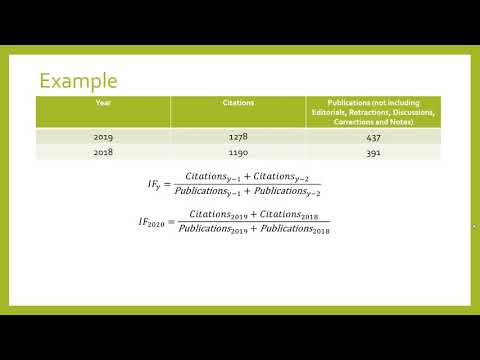
The IF of a journal is calculated by this database by taking two years the publication history of the journal divided by the total number of citations of a single year,

For example: If the journal has an impact factor of 5 in 2019, that means all the articles published in 2017 and 2018 have, on average, 5 citations each during that period.

The IF is used to compare the journal of a specific field not in the allied field and generally represent the statistical citation of that journal in the previous year means the IF of a journal in 2020 means the database of 2019.

Impact Factor will continue to be important while being criticized by others but it will have to grow and evolve within the system, the author level metrics, institutional level metrics; article-level metrics will ensure that these evolutions happen and if editors, editorial boards, or even authors can significantly self-cite the publication thereby affecting the IF.

Read: What Are Citation Metrics And Why Are They Important

Read:What’s i10-index? | How to calculate i-10 index for free

Role of Impact factor in Research publication

If you publish your research in a quality journal with a high IF, you will be able to get more citations for your paper as a result your citaion increase.

  • This is exactly what the impact factor is for, as well as giving your paper some value when you do your background research an communicate with others.
  • Currently, researchers are very keen on publishing their papers in journals with a high impact factor.
  • This is because they are evaluated for papers published in journals with a high impact factor and no intention from the scientific community of the same evaluation for papers submitted to any other journal.
  • Before submitting a paper, you should ensure you check the journal’s IF as it may adversely affect your research career.
  • A new journal will not get a place in the JCR database until after two years of existence and they would not have any factor because they are not getting cited in that database of research papers published.
  • It is important not only to publish your research papers in a new journal, but also to publish them in a journals that have a high impact factor as compared to other journals, which is a good is a good sign.
  • A good impact factor is one that is five or highe and higher the impact factor, the better the quality of your article will be.
  • If you publish a paper with a high impact factor today, you can expect to have a good number of citations in the future.
  • This will help you gain a greater degree of quality in the future, which will result in an increase in your increments or job status which is directly determined by the impact of your research.

Wrapping Up

This is all about this article and hopes these tips and tricks of impact factor calculation help you in your research and research journal discovery before publishing in a suitable research journal,

KressUp is an online learning platform, which brings novel articles from time to time, stay connected.

Please share and subscribe to our website, so that it can reach all people in need, and for more E-content, for research support, you can find it on our website or you can also write us an email for a free consultation.

Please feel free to share this article with other, if you like this

Related article:

General FAQ related to Impact factor in Research publication

Q 1. What is the significance of IF in Research Publications

An impact factor measures the importance of a journal by counting the number of times selected articles have been cited.

Q 2. Is IF really that important?

The impact factor of a journal measures how often its “average article” is cited and its importance relative to its peers.

Q 3. Does the publication matter to the IF of a journal

There are a number of journals that publish a lot of review articles and that have a high impact factor.

What is A Biodata | What Is A Resume | What Is A CV

These are simply outdated names for resumes or curriculum vitae, and biodata is an abbreviation for biographical data and is an obsolete phrase for resumes.

The emphasis in bio data is on personal details such as date of birth, religion, sexual orientation, race, nationality, residence, and marital status.

Following that, a chronological listing of education and experience is provided.

What Is A Biodata

Bio-data is a short form of biographical information, to be honest, mostly it is considered an old-fashioned name for a CV or resume, so people used to call it bio-data.

But earlier now they call CV and resume now this term is now only used for nonprofessional purposes like for marriages, etc.

If you are sending your details for marriage or something like that then it is called send your bio-data and this is mainly a one-page document about you which includes your details like date of birth gender religion race nationality residence marital status and qualification.

The basis of bio-data is that the predictive ability of a person’s past behavior is the best predictor of future behavior.

The biographical information is not expected to predict all future behaviors but it is useful in personnel selection in that manner so that it can give an indication of probable future behaviors based on an individual’s prior history or bio-data instruments.

What is a resume

The resume, well, it is used for professional purposes only, not for marriages and things like that.

The word “resume” originated from a French word which means summary.

Now this is usually longer than bio-data and shorter than a CV and contains details about your skills and qualifications. Its main focus is on your professional side and it is customized for a particular job.

The resume highlights the skills and experience that align well with the trades and employers looking for in their ideal candidate. Often these skills come from internships in part-time jobs and also from extracurricular activities.

Most importantly a resume illustrates your value to an employer by value means the type of results a job seeker has previously produced and can reproduce the same value in the next level in two categories productivity and probability from previous experiences.

There are many uses of resume and it is typically used for internship employment opportunities etc.

The content of the resume decides on a format that would get you noticed remember a resume is an opportunity to make a first impression good and the right format will help you tell your story more effectively to the employer.

When composing a resume, make sure it looks professional, utilize margins and a ruler with spellcheck, proofread and revise.

In a resume that includes relevant information the length of your resume should be one page but depending on your experience and skills, it can be more and all formatting should remain consistent.

We endorse you to pick one recommended formatting and stick with it throughout the document for the chronological format there are basic sections like the contact information education experience and skills but other sections can be used strategically depending on your experiences for example the objective statement summary qualifications are undertaken experience affiliations undergraduate research and projects in short.

What is a Curriculum Vita?

A CV is frequently known as a Curriculum Vita. Before talking about what a CV is, let’s talk about what it’s not. A CV is frequently known as a CV, and it is not a resume.

A resume is a list of your past jobs along with relevant skills and accomplishments in your career that you use in a job application and a CV is used to apply to positions related to academia typically opportunities in education science or research carrier.  

Curriculum vitae is a Latin word that means a course of life and, as the name suggests, it is not limited to a particular job profile; it is the overall profile and this is the most common term used nowadays in job interviews.

However, this is also for professional purposes and your details are optional.

You can write fewer details and focuses mainly on your qualification your experience your job profile etc

A Curriculum Vita can be more than two pages long. The average length of a CV is three pages.

However, it can go there is no limit it can be 10 pages long because it’s your opportunity to explain your experience and achievements in detail they’re usually listed in chronological order these are the sections CV should include your contact information education always first including thesis or dissertation honors and awards professional experience or employment, publications, presentations, extracurricular and volunteer experience and finally interests optional sections include objective or summary, certifications, and licensure professional affiliations professional activities research or added qualifications.

The main difference between a resume and a CV is that a CV is about your overall personality and a resume is mainly for a particular job profile.

Lessons show that an interviewer takes just 30 seconds to look at your CV or resume and decide whether they will give you that job or not.

In short, a CV is more like the scrapbook of your life while a resume is more like a picture consequently don’t be confused to present your right matter in the right place when needed.

Finally, I want to thank everyone for reading this article and hope that it helped you differentiate between these three scenarios so that you can choose and write your resume accordingly.

KRS is an academic collaborative research platform that regularly updates its information to aid in your professional development.

With every article, the  Koshal Research support (KRS) platform goal is to increase the level of your happiness health with a wealth of knowledge.

If this is your first visit to our site, we encourage you to share and subscribe in order to assist us in spreading the word. To gain additional assistance with electronic content and research, please visit our website or contact us via email at info@kressup.com to schedule a complimentary consultation.

How To Write A Report | Report Writing Structure | Format Of Report Writing

Hello Learners, if you are looking for report writing,

You are on the right track. We are here for you.

The first thing to look at when you are going to write a report is the report structure. The structure is very important because it will help us to organize your thoughts, and make it easier for other tutors to read your work, which will make them happier! A good way to do this is to use clear headings, subheadings, and numbering.

Write your title in the center of the page to include your name the date and for whom the report is written my chosen title is the evidence that includes the name and the date the time.

During report writing, if we follow the structure of the report writing it is quite simple and easy to write a report stepwise by breaking different headlines into paragraphs. 

For example, once you know the incident you can write the headline based on that, and after that, the opening paragraph becomes very easy when you follow these four questions, who, what, when, where, and then later on how and by these are the questions that you’re going to ask and then you have to include the evidence from experts and involved people and finalizing the report.

The structure of the report includes a title page terms of reference a summary alternately known as abstract content including a table of contents. 

A report structure consists of the following sections

I briefly explained how the effective report was written including the methods and this may form a subtitle or a single paragraph you need to provide.

The contents of the report containing the aims of the reports what was found in any recommendations the contents page shouldn’t or should list the various chapters and/or headings along with page numbers, you may number chapter headings and subheadings in addition to providing page references you need to be clear and consistent throughout the whole documents. 

Usually, there are many types of reports and styles of report writing. You could, once in a while, be requested to write different types of reports depending on your line of work or activities. You’ll need to provide key information about your working methods, objectives, successes, and difficulties you’ve encountered during the work.

In general, there are 8 report types: formal, short, informational, speculation, lateral or vertical, internal or external, and regular.

Introduction in Report Writing

In the introduction, you should include the aims and objectives of the reports and they should be explained in detail identifying problems or limitations in the scope of the report describes the research methods the parameters of the research include any necessary background history.

Methods in Report Writing

In the methods section, you need to explain the procedures followed the relevant information on materials used including sources of materials and details of any necessary preparation refer to any problems encountered and subsequent changes in procedure

Results in Report Writing

In the results section, you need to include a summary of the results of the investigation together with any necessary diagrams graphs, or tables of collated data that support your results remember to present your results in a logical order without comment

Discussion in Report Writing

In the discussion section of the report is the main body of the report and this is where you find your discussion the facts and evidence you have gathered should be analyzed and discussed with specific reference to the problem or issue consider section headings your points should be grouped arranged in an order that is logical and easy to follow we would advise you to use bullet points in an easy-to-follow list and remember to reference throughout

Conclusion in Report Writing

In this section, we summarize what we have concluded, from the successes and the failures. The conclusion should also, provide the link between our findings and our recommendations and you need to demonstrate the overall significance of your report and covered all important points which motivate the readers of that report or highlight the central issue or findings of your report and but no new material included in the conclusion.

Now, remember, the conclusion should discuss the information in the report, but we shouldn’t introduce any new information here.

Appendices in Report Writing

In the appendices, you might need to include the table’s graphs questionnaires surveys or transcripts refer to the appendices in the body of your reports such as Appendix A, Appendix B, etc

Acknowledgments in Report Writing

In the acknowledgment, you might need to include and thanks to the funding agency, persons, and institute who are directly and indirectly help you financially or morally during report writing.

Bibliography in Report Writing

In the bibliography, you should list in alphabetical order by author or publicist is referred to in your reports using the Harvard or Vancouver referencing style.

So that’s all in this article thank you for accepting this article, if you have any questions related to the report writing or you want to provide any suggestions please write in the comment section. If you liked this article do subscribe to KRS to get regular updates about the new articles published in the future.

Please share and subscribe to our website, so that it can reach all people in need, and for more E-content, for research support, you can find it on our website or you can also write us at info@kressup.com for a free consultation.
If you find this article useful, don’t forget to share it!

Related Articles:

General FAQ Related to Report Writing

Q 1. What is a Report

It is a type of writing that is organised around briefly outlining and analysing issues, things that have happened, or things that have been discovered physically in any situtions.

Q 2. Report writing means

A formal way to write indepth on a subject or topic.

Q 3. Type of report

Generally, reports are formal, short, informational, speculation, lateral or vertical, internal or external, and regular.

How To Prepare A Synopsis | How To Write A Synopsis

If you are a beginner or just starting your research or Ph.D. journey and come across the step of synopsis wiring,

You’re on the right track, and we’ll walk you through the process of creating a synopsis and synopsis structure. 

Actually, I have to choose this topic because I got lots of messages and mail that how to write a synopsis and it is really difficult for me to tell them all how to prepare a synopsis for them.

I better decided to prepare an article over this and I am going to prepare this in the English language only, but there is a language translation plugin in my blog and one who has any problem in English can switch to that language in which he/she is compatible with the description of synopsis writing.

What is a synopsis

It is an outline or summary of your research work to be conducted and this is the first stage of your research where you can start your research or your experiment or your work it is the most important step of research and the foremost thing in the synopsis is your topic you should choose the topic as of your interest because if you were not interested in the particular topic then it will be very difficult for you to experiment with that.

If you have no deep knowledge of that topic then it’s difficult for you to work on that particular topic and after choosing that relevant topic as per your the interest you should get an irrelevant guide and the guide should pick sport on that topic and it can be easier for you because, without a guide, it is just like you can’t easily conduct your research work.

So it’s better to choose a topic as per your convenience and your interest in the better guidance of export on that topic and when you provide the title for your topic.

The topic of research should be catchy and whenever you are talking about your topic with someone then they should express it oh wow you are working on this topic it’s a very good topic very interesting topic and if such types of expressions you must get for your topic you can get positive energy to work on that topic.

Different portions in a synopsis structure

  • Introduction
  • Review Of Literature
  • Objective
  • Hypothesis
  • Scope of topic
  • Research Methods
  • Bibliography

Introduction in synopsis 

Introduce your research topic in a very brief manner in an explanatory way so that even a student can easily understand or the one who doesn’t have any link with that topic can also understand and say oh you have chosen this topic.

This is your purpose of study all these points would be through very clear in your introduction your interests would be reflected in that topic and the positive point should be reflected in what you are going to face a problem it should be quite thoughtful from your introduction after introduction you will come to the literature review.

Literature review in a synopsis 

After introducing your topic now the time you will explain, what has been done on the particular topic, and what were the outcomes or drawbacks of the topic with proper referencing.

What were the steps or techniques used to improve the results of the work which has already been conducted, and if any contradictory point is there on that topic then you should also explain it because it always creates an interest in your mind that yes this is contradicted.

How we can conduct our work on this topic and how to overcome this contradictory point should be well explained in them and while explaining the literature review you will also add the significance of your topic by comparing your literature review then after this, the most important thing about your synopsis is the objective

 Objective in synopsis 

The objective itself explains the whole process and road map of your work with a stepwise procedure in it. All the experiments are conducted stepwise in your research you will note that in the objective and from the objective points themselves viewers or a reader of your synopsis can easily understand what you are going to conduct and what you are going to get.

Like you have started with the first objective that which was going for the data collection or the sample collection in the next objective you have introduced and analyzed the data and samples from different sources and conclusions will perform in the third objective and after that your outcomes respectively. How you are going to continue your hypothesis and how you can get a result of your hypothesis?

Hypothesis  in synopsis 

Suppose you’re planning for some tool at that time, what do you do? we give the hypothesis, For example, if that will be the rainy season then we should be our reserve car or a sort of reserve vehicle to travel for sampling or instead of going with the hired one in such types of hypotheses you keep in your mind for your research work.

You will also take such a hypothesis that who much amount of sample is expected and this area is very much drawn to particular data or particular sample and you must focus on this particular area and after it is supposed that you will get a good result from that particular sampling or particular data.

In such type of hypothesis, you first came about that, and after you say that after analyzing a sample we can conclude this must of things.

Actually, you are enhancing without or with your imagination that how you can get how you are conducting your experiment in your imaginations you will give a certain hypothesis and after hypothesis, this is your synopsis.

After putting your hypothesis you will then perform your work on that particular hypothesis and then we are either accept or reject your hypothesis.

Scope of the topic in a synopsis  

The scope of your topic is what you can get. What is the scope? Why you are conducting this research you are going to answer all why you were conducting this experiment and what is the scope of this experiment. If you are doing this research what are the positive results you are going to come and how it will affect you economically or socially to the environment?

Research methods in the synopsis 

This is we can say the techniques you are going to use for your research and what are instrument you are going to apply on that path. When you are going to represent all these things and going to offer any experiment or any research work at that time you are associated with a particular Institute to get the result from the research methods with the help of tools and techniques.

During the research work, you decide whether the expert faculty in that Institute or not or whether you have to turn to an export of your tools from anywhere or whatever the financial status for your research is either you can get from your institute or not. These things can be cleared from the research methods and design.

You can frame a schedule that I am going to complete my first objective in this the first year or in six months and for other objects, you are going to give a tentative duration respectively and it will become specific to you to complete your work in that decision time and if you will not have any tentative durations or any limitations of timing in your research then what will happen you will keep on working on one thing and you will keep on doing out spend lots and lots of time at that particular topic.

You have a tentative duration of research and it should complete your work at that particular time and you should be very attentive to your research work for that, we then finally come to the bibliography

Bibliography  in synopsis 

This is the referring session and you can also provide a list of all sources you have used in the process of referring or design of your synopsis or writing your synopsis including the research papers, books, academic studies, etc.

All sources you have gone through during the synopsis preparation and updated about your topic and these all kinds of stuff should be included in the synopsis.

So this is all about “How to write a synopsis” and hopefully, this article helps you during the synopsis preparation and it would be easier for you to write a synopsis in the future. KRS is an academic collaborative research platform that regularly updates its information to aid in your professional development.

If this is your first visit to our site, we encourage you to share and subscribe in order to assist us in spreading the word. To gain additional assistance with electronic content and research, please visit our website or contact us via email at info@kressup.com to schedule a complimentary consultation.

 If you find this article useful, don’t forget to share it!

Related Articles:

General FAQ Related to Synopsis

Q 1. What is a Synopsis in Research

A synopsis provides readers with a concise outline of the key ideas and progression of the proposed work.

Q 2. What are the main parts of the synopsis

The meaning and significance of the research

Q 3. Type of synopsis

Two types first is a research synopsis, and the second is a project synopsis. 

What is plagiarism | Different types of plagiarism commonly used

Probably we heard a lot about plagiarism as a student and researchers during our education. So it is defined as a steal or copy-paste content and passes off the ideas or words of another as one’s own to use another creation without crediting the source reference and generally we say that this is stealing as if it’s criminal. But it can carry some serious consequences in any institute or academic has its own plagiarism policy or academic honesty policy but students who plagiarize may get reported to institute officials and get punished on that assignment or write up and in some cases even expelled from the institute or course in which he/she is enrolled. It is using someone else’s words without giving them proper credit in your paper and stealing that’s right stealing another writer’s work let’s look at this situation. It is defined as the representation of another author’s language thoughts idea or expression as one’s own original work research paper key language good thoughts core idea co-happening

Example: Let’s look at the situation you find an article on the internet that says exactly what you would like to say in your essay or document and you copy a few sentences and forget to add a citation this is still plagiarism you might have made an honest mistake in forgetting your citation but if you do not include citation it looks like you are using someone else’s words and you try to slide them by as your own.

During the document writing one should take care while writing in the idea which is still someone else’s and some of the words are taken copying from another writer exactly as printed with no changes that include plagiarism final and tragic words which were used in the source text they’re not very many words but notice that all of the ideas and all of the information that included in his or her essay came from another writer, in this case, he/she must document its meaning at the end of this paragraph there needs to add a parenthetical citation with the true author’s name and information to avoid plagiarism.

Sometimes students use to describe plagiarism include cheating copying someone’s work dishonest and claiming credit for someone’s work that’s not yours. Let’s start to discuss commonly used plagiarism.

Some commonly used plagiarism by authors

First type of plagiarism is Cloning

Cloning involves submitting another’s written work as your own. It is defined as turning in someone else’s paper or homework assignment and just writing your name on it and submits or publishes. You’ve taken a complete assignment or paper and turned it in as your own.

Second type of plagiarism is ctrl C

A ctrl C is a shortcut on your laptop and PC that copies text that contains a significant portion of text from a single source without alteration,  it is called “ctrl C”. This form of plagiarism is essentially copying and pasting your assignment paper or project from related sources without any citation quotes or credit to the author. You’ve taken a sentence or whole paper and turned it in as your own.

Third type of plagiarism is found and replace

In this case, a few keywords and phrases are changed with the help of the relevant replace button of software, but the essential content of the sources remains as such. This form of plagiarism happens when you find something to put in your assignment and instead of copying it entirely. You just change a few keywords or phrases. This is still considered plagiarism because you’ve taken someone else’s ideas and not given them credit.

Fourth type of plagiarism is remixing

In this case, one can involve paraphrasing from other sources and making the content fit together seamlessly. In this type of case, plagiarism happens when you don’t give credit to a source from where you learn something. All the information learned during research would be new information that I need to cite.

Fifth type of plagiarism is recycling

Recycling is the act of borrowing generously from one’s previous work without citations and you should aware that you can’t reuse your previous work without prior approval by your professor and publisher in which you publish your work.

You are avoiding plagiarism while writing documents, In short here’s the main key bottom line for writing a plagiarism-free document. Whenever you use an outside source to write your essay you must document that source in your list of references. When you paraphrase or when you copy word for word in a document and do not create the complete writing yourself then you must certify form where you got this information whether it’s one sentence two sentences or a whole paragraph if you use another writers ideas or words within your writing then you must document the source and that is the key to avoiding plagiarism. You can use plagiarism checker software for detecting you copy and paste the content in your essay and find the report

This is all about this article and hopefully, this article will help you to avoid copy past and make your assignment, scientific paper unique and you can write a plagiarism-free document, KRS is an online learning platform, which brings novel articles from time to time, stay connected.

Please share and subscribe to our website, so that it can reach all people in need, and for more E-content, for research support, you can find it on our website or you can also write us at info@kressup.com for a free consultation.

FAQ on Plagiarism

Q 1. What is plagiarism in simple word

Answer: Plagiarism is a trim or copy-paste of someone else’s words or documents without giving them proper credit in your documents and generally, we say that this is stealing another writer or published work.

Q 2. What is the example of plagiarism

Answer: For example, you find an article online that says exactly what you would like to say in your essay or document and you copy these sentences and add in your documents, but forget to cite the source if you do not include citation it looks like you are using someone else’s words and you try to slide them by as your own.

Q 3. What is the type of plagiarism

Answer: The common type of plagiarism
The first type is cloning and in this type of plagiarism is one can rotating someone else’s research paper or homework assignment and just writing your name on it and submits or publishes it.
 
The second type is Ctrl C and in this type of plagiarism is one can copying and pasting any assignment, paper, or project from related sources without any citation quotes or credit to the author.
 
The third type is found and replaces in this case one can change a few keywords and phrases with the help of the relevant replace button of software, but the essential content of the sources remains as such.
 
The fourth type is remixing in this case one can involve paraphrasing from other sources and making the content fit together seamlessly.
 
The fifth type is recycling and in this case, one can copying generously from one’s previous work without citations without prior approval by your professor and publisher in which you publish your work.