About KressUp

Information | Knowledge | Wisdom

How To Write A Plagiarism-Free Research Paper or Thesis

If you are searching for a plagiarism-free research paper writing process and are having trouble, try these instead.

It’s good to have you here because in this article we are here to prove a solution to you with 7 best tips to write a plagiarism-free research paper or thesis and strategies to write when you start

It is certain that if you follow these guidelines when creating your content, you may eliminate any instances of plagiarism and produce an original research paper.

Its our guaranteed that if you are using these tips and writing your content, you can get rid of the plagiarism text and successfully write a unique research paper.

The process of gathering relevant literature and providing evidence to support your research paper can be difficult if you do not conduct a proper literature review before writing your paper.

The illustration of the previously established ideas and values, as well as including relevant information in your paper, are necessary steps, but they must be taken from any sources with caution to avoid plagiarism.

To understand how to avoid plagiarism, you must first understand what plagiarism is.

Read: What is plagiarism | Different types of plagiarism used

Plagiarism is defined as the use of another author or person’s words or ideas without giving proper credit to the original author.

Plagiarism can be intentional, such as when someone steals another’s work, but it is more often unintentional, such as when someone is careless or forgetful use other sources.

When you start writing an academic paper or thesis, you build outlines of your work on the basis of others’ work and gather information and evidence related to your work from a variety of sources.

You must incorporate these sources into your text to avoid plagiarism and you can create plagiarism-free content easily.

Read: How To use Quillbot  For Remove Plagiarism and Paraphrasing

Note: Avoid plagiarism at all costs, even if it is unintentional, because plagiarism is a crime.

7 Best Tips to Write a Plagiarism-Free Research Paper or Thesis

Avoid Copy Paste

On your laptop or PC, the copy keyboard command is Ctrl + C, while the paste keyboard instruction is Ctrl + V. Copying text including a substantial chunk of text from a single source without alteration is known as “ctrl C.”

This way of cheating or plagiarism involves copying and pasting your assignment paper or project-related resources into a form without quoting or thanking the author. You rewrote a line or a whole document to make it your own and avoid direct copy-paste.

Create your own ideas.

Instead of repeating the source’s ideas or words, think about what you can add to the conversation. Consider what point you can bring to your writing that is entirely your own. Remember that if you’re using a source’s ideas or words to make a point, you’ll still need to follow the rules to avoid plagiarizing.

It’s tempting to recycle some of your earlier words if you’re writing on the same topic for many assignments this is known as “self-plagiarism.” If your publisher or mentor has not given you permission to republish your old work, the risk of plagiarism is very high.

Content paraphrasing

Rewriting a source’s ideas or information into your own words without affecting its meaning is known as paraphrasing, but if this process is prepared incorrectly, paraphrasing might lead to plagiarism.

It’s a bit good to do a successful paraphrase without plagiarizing. Try to avoid using too many comparable terms or phrases from the source while rewording and formatting your content. The trick is to do this without changing the idea’s meaning and don’t forget to add a quote to the source because you are still using someone else’s opinion.

In paraphrasing, you can change the main idea of the author by reshaped and shortened the original order of information and structure of sentences. 

Even if the material is presented in the same sequence and structure it would almost certainly be detected as plagiarized and be sure that your written text is not too closely related to the source.

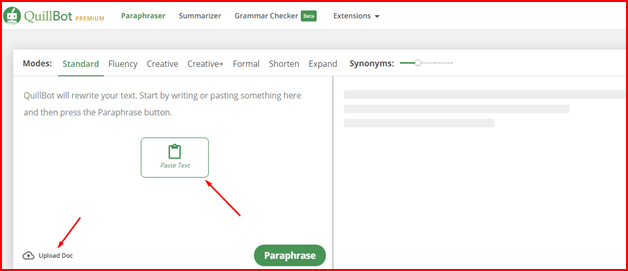
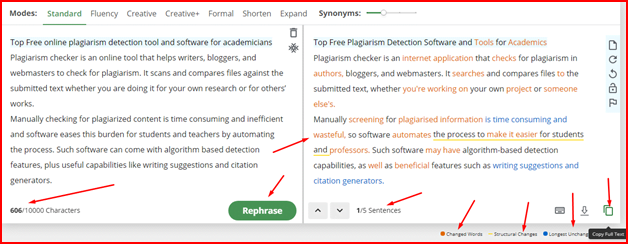
You can also use online software and tools for paraphrasing.

Make use of quotations

To show that the material was derived from another source, use quotation marks. The quotes should be written precisely as they appear in the source paper.

Copying a piece of text word for word is known as quoting. The copied text must be introduced in your own words, with quotation marks around it, and the original author correctly credited.

If you use the source words literally in your writing, one of the basic but obvious ways to avoid cheating is around the text with quotation marks to show that the words do not belong to you. Direct quotes should include source quotes so that readers can see where the discount is coming from.

Mention the original sources.

You must add an in-text reference (or a footnote citation) that identifies the original author every time you quote or paraphrase. It frequently includes the year of publication as well as a page number.

Each in-text citation must be followed by a full reference in your paper’s reference list or bibliography. This explains where the material comes from in detail, allowing your readers to track down the source on their own.

There are numerous citation styles, each with its own set of criteria for citing. APA, MLA, and Chicago Style are among the most popular. The most critical aspect is to use the same style throughout the content.

It is necessary to cite any words or ideas that are not your own and were copied from another article.

Cite Your Own Work you must cite yourself if you use material from a previous article. Self-plagiarism is when you use material you’ve already published without citing it.

You should not cite the scientific facts you received after executing your tests.

It is not necessary to cite facts or common knowledge. Include a reference if you’re unsure.

Maintain a list of your sources

Make a list of all the sources and information you can find when you do research and take records of your all work. One way most of the students practice cheating is by forgetting the sources and fail to add that where the idea came from and presenting it as unintentional.

By keeping your notes organized and producing a list of citations as you go, you may easily avoid this plagiarism issue. Keep note of all the sources you use, including websites, magazine articles, research papers, and videos, in addition to books and journal articles, which help you and you can easily go back and check where you found the name, fact, or idea of ​​your article

You can use an index card or any other low-tech technique to keep track of your research sources or keep note of the sources you use during your investigation.

Note the bibliographic information for the source on the top of the card so you’ll have it when you need to cite it in your bibliography.

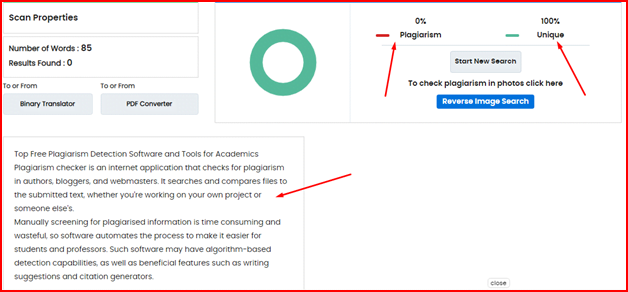
Make use of plagiarism detector tools.

Some phrases or lines may remain with you so well while researching a topic that you mistakenly include them in your work without a citation. If you’re unsure, an online plagiarism checker can help you spot these errors before you submit your paper.

Plagiarism checkers are used by most colleges to identify plagiarism in student papers. This technology scans your paper and compares it to a large database of publications and websites, highlighting passages that are too similar to other materials.

Read:Top Free Plagiarism Checker Software and Tool Available Online

Before submitting your paper, you can use a plagiarism checker on your own. This can help you spot any places where you’ve neglected to cite something, omitted quotation marks, or added a paraphrase that’s too close to the original text. Then you may easily rectify any instances of possible plagiarism by following the instructions above.

Between plagiarism checkers, there are variances in accuracy and safety. All of the options have been evaluated and compared which lead to unique documents.

This concludes the 7 best techniques for avoiding plagiarism and effortlessly writing a plagiarism-free research paper or thesis; maybe, it will assist you in writing plagiarism-free content in the future.

KRS is an academic cum research platform that helps you progress your career by bridging the gap between academia and industry.

If this is your first visit to our blog, please share and subscribe to ensure that it reaches the widest possible audience. Visit our website for more E-content and research assistance, or email us at info@kressup.com for a free consultation.

If you find this article useful, don’t forget to share it!

Related Articles:

General FAQ Related To Plagiarism-Free

UGC Academic Job Portal For NET / JRF / SET / Ph.D. Qualified Candidates, Employers, and Step To Step Registration Process

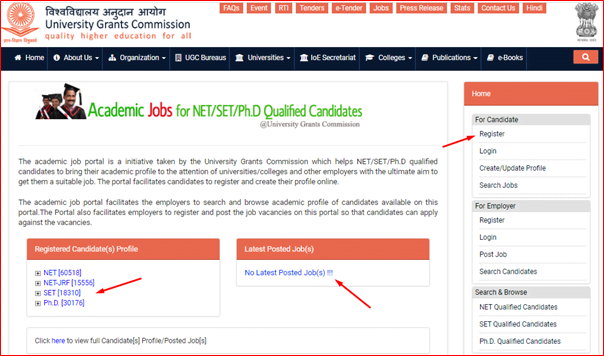
In this article, we are talking about the new UGC Academic Job Portal for NET, SET, and Ph.D., according to a statement issued and published on 16-06-2021 UGC Letter reg. Academic Work Portal by the University Grants Commission, that the job portal helps employers to search and browse the study profiles of candidates for the jobs.

Applicants wishing to use the portal services will register and create their online profile by visiting the official website site of the UGC Job portal and registering his/her self.

The UGC Academic Job Portal will help candidates submit their academic profile to universities or colleges and to other platforms to find suitable employment at a university, college, or other tertiary institution.

The site also helps employers to register and fill vacancies on the site so that applicants can apply for vacancies.

In addition, the UG commission is also in the process of developing a career by introducing Non-Teaching posts and is keen to add new features. The upgraded site will also be available for candidates and employers soon.

The UGC also asked employers to upload their vacancies to a job portal that will help out this information to the eligible candidates.   

Step To Step Registration Process for UGC Academic Job

Step 1: Go to the UGC Academic Portal website, then look to the right, Click to register and join for free

Note: You can also check the status of all NET / JRF / SET / PhD registered candidate subject vise on this portal and search for jobs posted by different institutes.

Step 2: Enter all the specified details and after completing the security key click on register

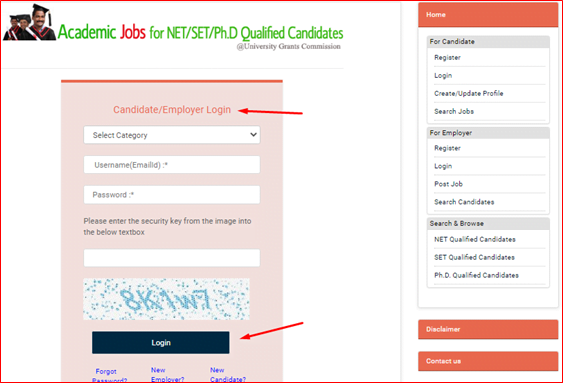
Step 3: You receive a successful sign up message display  and you can see a  new candidate login dashboard automatically,, you need to login by selecting as an option, enter your registered email id and password security and click login

Step 4: Now, Your registration process almost completed and you get your own board containing personal details, qualifications, and job information and publishing categories

Note: Now you can fill in all the information one by one by clicking on create / edit profile sections

Step 5: Fill in all personal and contact information correctly and click save on the following

Step 6: Next, add the qualification information and work experience to date correctly and click save and next

Step 7: Add details of the publication that has been properly addressed and click save and next

Step 8: Now you reach on the final step, add other relevant information if any, and click agree button and save

Step 9: You have finally done UGC say you registration has been completed successful, Click ok butten

Cheers  and you are  now ready for Job’s search !

Step 10:  For sing out, hit the icon marked with an arrow in the next image and then click Log Out.

Step 11: To sign in again, visit the  UGC Academic portal click to sign in and with your registered email and password you can sign in

Note: You can update your profile from time to time and add your own experience with research and publishing etc.

This is all about this article and process of registration in the UGC Academic Job Portal on the UGC website and I hope it will help you in your search for a job in any higher education institute, KRS is an educational cum research platform, helping you to advance your carrier.

If this is your first time here on this blog, this blog to improve your reading skills, and research, before leaving please share and subscribe to our blog so that it can reach all people who need help, and more E-content, research support, you can find on our website or write to us here is info@kressup.com for a free consultation.

If you find this article useful, don’t forget to share it!

Related Articles:

Free Scholarship Scheme For Indian Student’s

If your financial difficulties may prevent you from finishing your education, even though it is more crucial. If this is the case, don’t worry; we are offering you free scholarship alternatives.

“Padhega India,tabhi to badhega India”

The main purpose of any scholarship scheme is to provide financial assistance to eligible candidates for advanced study and research, leading to PG, M. Phil. / Ph. D. Degree in Humanities and Social Sciences including Language and Science.

After your master’s, you do not need to be a NET or a qualified JRF. The scheme is based only on standard eligibility procedures and need not qualify for any national-level examination.

In this article, we are talking about the UGC /AICTE scholarship scheme in India.

The objective of the Scholarship

The key objective is to support the student by providing them with financial aid during their studies.

The program is open to Indian students only, who are pursuing Post Graduate courses such as full-time science, Humanities, Social Sciences, and Engineering & Technology.

The scheme is not applicable for any distance or private courses.

The fallibility or number of slots for each program varies from year to year in all subjects. The 3% merger is reserved for selected disabled people.

You may previously have benefited from these schemes on the UGC website by visiting the e-Scholarship-Fellowship Award Registration Tracking System.

But now it has been shifted to the website name National Scholarship Portal under the heading UGC /AICTE Schemes and these schemes are further dived into two captions on the basis of applicants.

  1. University Grants Commission – MHRD for Postgraduate Course
  2. All India Council for Technical Education-AICTE for Technical Courses

List of scholarship scheme under University Grants Commission- MHRD

1. ISHAN UDAY – Special Scholarship Scheme For The North East Region

To improve GER, promote higher education, and encourage children in the economically disadvantaged category in the NE region, the UGC has decided to introduce a Special Scholarship Scheme for the North East Region from 2014-15 onward named “ISHAN UDAY”.

The scheme application process

 Applications will be invited annually to the National e-Scholarship Portal of the Government of India. A brief notice will also be uploaded to the UGC website.

At the time of application, the course will be considered a standard or technical degree by the University / Institute / College concerned.  Only online guaranteed applications will be considered for the award of the scholarship.

Guidelines for ISHAN UDAY Scholarship Scheme

2. Postgraduate Indira Gandhi Scholarship for Single Girl Child

In order to achieve and promote girls ‘education, the UGC has introduced the Post Graduate Indira Gandhi Scholarship for Single Girl Child with the aim of paying the direct costs of girls’ education at all levels, especially such girls who are the only girls in their family,

The scheme application process

Applications will be invited annually to the National e-Scholarship Portal of the Government of India. A brief notice will also be uploaded to the UGC website. The host institute is required to verify the online application and expected that in institutions where a student has taken a first-year PG course, no tuition fee will be charged by the institution from female students for a PG degree at a university/college/institution

Guidelines for Single Girl Scholarship Scheme

3. Postgraduate Scholarship University Rank Holders (1st and 2nd Rank Holders)

The aim of the program is to attract talent to pursue postgraduate studies without strengthening basic education at the Undergraduate level. Winners, under this program, can continue their graduate program in any professional field at any tertiary institution in the country.

The scheme application process

Applications will be invited annually to the National Scholarship Portal of the Government of India and s brief notice will also be uploaded to the UGC website.  Only certified online applications will be considered for a scholarship. The University / Institution should verify the 1st and 2nd rank of the student and must ensure that the applicant is suitable for the scholarship as specified in the guidelines.

Guidelines for University Rank Scholarship Scheme

4. Postgraduate Scholarship Scheme For ST/SC Students For Perusing Professional Courses

The program has been implemented to maintain the social background of the nominees in a community-based category and provide them with the opportunity to pursue advanced studies in technical fields such as Engineering & Technology, Management, Pharmacy, etc. at Indian Universities / Institutions / Colleges.

 The scheme application process

The applicant or nominees are required to apply online at the National Scholarship Portal following an advertisement that will be published by the UGC once a year through the leading newspaper and Employment News and on the UGC website and the host institute needs to confirm the online application.

Guidelines for ST/SC Scholarship Scheme

5. Swami Vivekananda Single Girl Child Scholarship Research

Promoting women’s education is one of the main objectives of our education policy. In keeping with Swami Vivekananda’s views on women’s education and the achievement and promotion of girls’ education, the UGC introduced the Swami Vivekananda Fellowship for Single Girl Child research in Social Sciences with the aim of paying for the higher costs of higher education especially such girls.

Guidelines for Swami Vivekananda Scholarship Scheme (Waiting for Revision)

Note: After thoroughly reading the Guidelines for each scheme, the applicants need to find the right scholarship for you and register his/her self-online by visiting the Portal National Scholarship Portal.

List of scholarships under the All India Council for Technical Education-AICTE

All the applicants must follow the APPLICATION PROCEDURE for the Indian National Council for Technical Education – AICTE mentioned in the Guideline section of each scholarship scheme

1) A candidate who meets the eligibility criteria is required to apply online at the National Scholarship Portal (NSP) after the start of the application process and the notice to be published on the AICTE website.

2) The host institute where the applicants is studying, is required to verify and confirm the online application

 3) The relevant Department of Technical Education (DTE) of the relevant Government / UT will verify these applications as the second stage of evaluation as per the guideline of each scholarship scheme, for which the suitable candidate applied

1. Pragati Scholarship Program For Girl Students (Technical Degree)

The scheme used by AICTE aims to provide assistance to the development of girls pursuing technical education. Education is one of the most important ways to empower women with the knowledge, skills, and confidence needed to participate fully in the development process. This is an effort to give young women the opportunity to further their education and prepare for a prosperous future “Empowering Women through Technical Education”

Guidelines for Pragati Scholarship Scheme

2. Pragati Scholarship scheme For Girl Students (Technical Diploma)

The scheme used by AICTE aims to provide assistance to the development of girls pursuing technical education. Education is one of the most important ways to empower women with the knowledge, skills, and confidence needed to participate fully in the development process. This is an effort to give young women the opportunity to further their education and prepare for a successful future “Empowering Women through Technical Education”.

 Guidelines for Pragati Scholarship Scheme

3. Saksham Scholarship Scheme For Special Abled students (Technical Degree)

Saksham MHRD Scheme used by AICTE aims to encourage and support children with special disabilities to take technical courses. This is an effort to give every young, especially disabled learner, the opportunity to continue learning and prepare for a successful future through education / technical knowledge.

Guidelines for Saksham Scholarship Scheme

4. Saksham Scholarship scheme For Special abled students (Technical Diploma)

Saksham MHRD Scheme used by AICTE aims to encourage and support children with special disabilities to take technical courses. This is an effort to give every young, especially disabled learner, the opportunity to continue learning and prepare for a successful future through education / technical knowledge.

Guidelines for Saksham Scholarship Scheme

This is about this topic and I hope that these free UGC / AICTE Independent Scholarship programs, hopefully, help you with your study carrier and you can easily use them, KRS is a cum research platform, which helps you to advance your network by bringing new articles from time to time, stay connected.

If this is your first time here on this blog, this blog to improve your academic and research skills, please share and subscribe to our blog so that it can reach all people who need help, and find out more about E-content, to support research, you can find it on our website or write to us here info@kressup.com to get a free consultation

If you find this article useful, don’t forget to share it!

Related Articles:

General FAQ Related to Scholarship

What is an independent scholarship?

It is the financial support, obtainable to any student outside the university who usually has a Master’s degree or Ph.D.

What does the scholarship mean?

It is financial aid available for the student including tuition fees and fair supposed to be a living allowance or any other grant to help a student, an expert during his or her studies at any institution.

How do I apply for a scholarship?

Visit the National portal or other website and search for the program and check eligibility, other required information and apply for that Scholarship online.

What are the best scholarship websites?

There are many, however, the National Scholarship Portal is the Best one.   

Research Journal Metric to Understand the Journal Criteria for Paper Submission

If you are searching for the journal for your research paper publication

you have to know the criteria of a reputed journal matric and after the evaluation, you can decide whether either journal is good or not

In this article, we are going to discuss the Top journal metric used for Journal  evaluation and indexing which decide the criteria of a journal

all these metrics are world-renowned and mostly used for the evaluation of the journal criteria, all these metrics discussed in this article are picked from reliable sources like web of science, Scopus, and expert advice

if you find any difficulty email us for any help

If you decide to submit your manuscript for publication in a research journal, it is important to understand the common journal metrics which help you decide whether the journal is suitable for your publication or not.

Journal metrics are the measurement, and comparison of scientific and scholarly publications, often on any database, and are also referred to as journal impact, journal importance, journal ranking, and journal evaluations which allow scientists and researchers to compare peer-reviewed scientific journals with other journals, magazines, and more.

Here are some of the most popular metrics used for the calculation of journal metrics, and these metrics,  are usually divided into different categories on the basis of source, like Web of Science, Google Scholar, Scopus, and the Journal Citation Report sources used for the calculation of the journal metric.

The database is used to calculate each journal or magazine’s metrics on the basis of the criteria set and the statements and figures that are used to measure the prestige of a journal within its database.

In general, all the reputed journals are analyzed on the basis of the following metrics.

Please note: There are no perfect indicators for the evaluation of the journal metric and the pro and cons of each of the metric systems of measures are there. However, we must trust some metrics for the selection of a suitable journal for our research paper, which will save our time and effort, and ensures a quality solution.

Read:

Top journal metric used for Journal  evaluation

The 5-Year Impact Factor metric  (Web of science

The Impact Factor is calculated by collecting the citation score of each article and the number of articles published in the last 5 years.

The 5-year impact factor is the average number of citations on articles published within the last five years, as per the JCR year report and it is calculated by dividing the number of citations in a JCR year by the total number of articles published in the last five years.

The calculation is as follows

The Eigenfactors Metric (Web of science

In many fields, scientific papers are often not cited, within a few years of their publication and in this, the citation data in the first two years after the date of publication may be misleading.

The Eigenfactor score and the impact score of the items have been calculated on the basis of citations received in a period of five years.

Hence the Eigenfactor is based on the weighted citations per JCR year by the articles published within the last 5 years. Citations are weighted by the prestige of the cited journal, and quotes from high-ranking journals, to contribute to their own factor, rather than low-ranked journals.

Source: Eigenfactor

The Article influence metric  (Web of science

Article influence shall be calculated by dividing the Eigenfactor score, by a percentage of all of the articles and journals recorded in the citation reports that were published in the pages of this magazine and its rating will be determined by the average of the effect of the item (s) within the first five years of its publication.

It is calculated by multiplying the equity factor is 0.01, and dividing the result by the number of articles in the journal, normalized as a share of all articles in all publications.

The equation is as follows:

Where X = 5 years, the number of articles in journals and Magazines, divided by a 5-year, the number of articles from all journals.

The Article influence metric  (Web of science

The immediacy index is the average number of citations of a paper in the year of its publication and this index is calculated by dividing the number of citations to articles published in a given year by the total number of articles published this year.

Because of this, it is to the average value for each of the articles, the Immediacy Index, and has the tendency to discount the benefits of large logs across the world.  

The journal Immediacy Index is calculated by using the following formula:

The journal immediacy index indicates how quickly an article is cited.

The Impact factor metric (Web of science

The Impact factor of a journal is calculated by any database by taking the average number of citations on articles published within the last two years and in the JCR year.

The impact factor is calculated by dividing the number of citations per JCR year by the total number of articles published in the previous two years.

For example: If the journal has an impact factor of 10 in 2020, that means all the articles published in 2018 and 2019 have, on average, 10 citations each during that period

 For example, we calculate the IF of journal X in 2020

In this case, we take data only from citable articles published from 2018 to 2019 years

The CiteScore metric (Scopus metric) 

CiteScore metric is the part of the Scopus Data, which is the SNIP (Source Normalized Impact on the Stock), SJR (SCImago Journal Rank), and the number of citations and documents, and the percentages are enclosed in quotation marks.

With the inclusion of such data in Scopus, you can get information about the impact of citations for more than 22,220 titles.

CiteScore metrics are part of the permanent collection of the research data available on or Scopus database and support a holistic view of the results of the study.

CiteScore is the number of citations received by the journal in one year to documents published in the three previous years, divided by the number of documents indexed in Scopus published in the same three-year period.

The SJR metric (Scopus metric)

The SCImago Journal Rank (SJR) is the average number of weighted citations received in a particular year by the documents published in a particular journal during the previous three years, i.e., weighted citations received in year X to documents published in a journal during the period of the X-1, X-2, and X-3.

Citations can be definite as the prestige of the cited journal, and so a direct citation from a top-ranked journal will have a greater impact than just a citation from a low-ranked, and research.

For example, you can see the SJR score of the Journal on SJR journal ranking, with the help of various disciplines, journals, subject categories, and publications in the following regions/countries, in the year of publication

The SNIP metric (Scopus metric)

The source of Normalizing Effect on the Paper (SNIP) measures the average citation at the year X to papers published in the last 3 years. The citation is added to the citation potential of a specific journal category, which is the metric of comparison across the different disciplines.

It does this by comparing each of the journal’s citations by publication and the citation potential of the area, which is defined as a set of publications citing that journal.

So, the SNIP is the quick and easy way to measure the citation impact and allows you to compare journals in a variety of fields because the cost of a direct citation is greater for journals in the areas where the citation is to reduce the frequency, and vice-versa.

The SNIP will be calculated annually on the basis of Scopus data, and it is freely available, along with a CiteScore and SJR at Scopus Website

The Google Scholar Metric (Google Scholar)

It provides authors an easy way to make a quick review of the visibility and the impact of recent articles in scholarly publications and summarize the recent links to several publications, to help authors as they consider where to publish their new research.

The most important metric for Google Scholar is the H5-index, which is based on the articles published in the last 5 full calendar years.

Read: How To Conduct A Literature Review Using Google Scholar Step By Step Guide

It seems to that of h-index, but it also includes the most frequently cited h articles (h-core), and the median number of citations, h-median), and one can check these citations of each article by clicking on the H-index

You can check out the Google metric of journals on the Google scholar baseboard by the selection, category of the journal, subcategories for specific publications in all languages, and their names.

The H-index metric (any sources)

The H-index has been calculated on the basis of data from a variety of sources, such as Web of Science, Google Scholar or Scopus, etc. The h-index attempts to measure the productivity and citation rate of all of an author’s published work.

Read:

It indicator that determines the number of articles (h), which has been cited at least h times of the day

For example, the h-index is 25, which means 25 articles have been cited at least 25 times each.

Please note: Due to the differences in coverage between citation databases, and for each resource, you can specify a different value of the h-index for each author.

Let’s calculate the h-index of a journal having 10 articles (h) that received at least  8 citations. To measure the performance of peer-reviewed scientific journals, and scientific impact, as well as links to the scientists, countries, etc.

The journal total article count is 9 and out of which almost the first 8 papers (1 to 8) are cited at least 8 times or more

Hence the H-index value is = 8

Last but not least ISI ranking and Altmetrics are also used for the calculation of journal metrics.

ISI ranking metric: In this metric, the rating of the journals is on the base of impact factor, and the rating must be 2 years old or a 5-year-old impact factor and sourced by a web of science. Do not compare 2 years ranking with the 5 year ranking of a journal. “The position has always been in the context of a particular class.” In this section, you will need to see the logs in the same category and type. Therefore, the logs are ordered within a given category based on theirs.

Altmetrics metric;  It is a metric of any of the sources, such as Scopus, Web of Science, PubMed Central, and Google Scholar citations; citations in the document.

Altmetrics goes beyond the traditional citation metrics for the measurement of social visibility around a scientific article. This information is based on a wide range of metrics, such as tweets, blog mentions, news, sites, media, social bookmarks, reviews, articles, and downloads.

Wrapping Up

This is all about this article and hopes these journal metrics help you in the section of the journal before submission of your paper to that particular journal,

KRS is an academic cum research platform, which helps you in your carrier advancement by bringing new articles from time to time, stay connected.

If this is your first time here at this blog, this blog is to develop your academic skills, and research, please share and subscribe to our blog so that it can reach all people in need, and for more E-content, for research support, you can find it on our website or you can also write us at info@kressup.com for a free consultation.

If you find this article useful don’t forget to share it with others

Related articles:

General FAQ Related to Journal Metrics

Q 1. What is the Journal Metrics Meaning?

It is defined as the measurements, and comparison of scientific research and scientific publications, often in a database.

Q 2. How do I find journal metrics?

All of the indicators of metrics are based on the journals indexed by the Web of Science, can be found in the Journal Citation Reports, and Google scholar, and some of the Scopus-based metrics can be obtained from the SCOPUS platform.

Q 3. What are the Different Types of Journal Metrics?

Original metrics are the journal’s impact factor, which was founded in 1950 and is also available by means of the Thompson Reuters citation (JCR) Reports. Recently, a lot of the other free journals’ metrics and statistics have been published, including CiteScore, Eigenfactor, Google Scholar Data, SCImago Journal & Country Rank (SJR), and Source Normalized Impact per Paper (SNIP), etc  

Q 4. Why Journal Metric is Important

They can be used to evaluate the impact of a journal, and this impact value of a journal is the official assessment and journals credit rating, which allows scientists and researchers to compare these journals  in the scientific literature with other journals, magazines,  and newsletters, etc

The Importance of Yoga In Everyday Life

Yoga is a set of exercises, poses, breathing techniques, and meditations,  used for the rejuvenation of body and soul, you can change your lifestyle by performing these exercises in everyday life.

What is Yoga?

In ancient India, Yoga Was originated and called Yoog, In Sanskrit “Yoking” or “Union” is the set of physical, mental, and spiritual practices  

Some people are reluctant to exercise but when they do yoga they are able to benefit their body and relax.

So you should find a yoga class near you where you can practice different types of yoga in different styles. Yoga is beneficial for all human beings.  

Types of Yoga

The Yoga Sutras of Patanjali describe two classes of yoga practices: primary and secondary Yoga. Only the primary yoga practices can be performed alone, or they can be done with other people. The primary practices in the different styles include kundalini yoga and those based on Ashtanga and Bikram.

Yoga is a natural way of becoming human

It means the union of the spirit with the body. Without Yoga, man cannot become a human being. The individual psyche or soul is to be united with the body.

The body and the mind is the basis of personality. One without the other is a half of the whole personality.

Yoga means union of spirit and body. By unity with the body, we become human. If we do not unite the spirit with the body, then we cannot be human. We remain animals or plants.

By Yoga we may become human beings, enjoying the infinite possibilities. By making the body attractive, we can bring the spirit under our control and control it. It is said that Yoga is to bring the spiritual world into the material world.

Yoga in Everyday Life

Modern life is more stressful and we need to relax. If we are unable to relax we will face health issues. And then we will not be able to enjoy anything in life.

There are many scientific pieces of evidence that yoga calms the mind, helps in stress management, and helps to become a balanced human being.

However, if you practice yoga regularly you will feel good from the inside because it brings mental and physical discipline to achieve peace of mind and you can live a stress-free life

Yoga is good for children as it helps in creating better concentration in their minds, apart from helping them in their studies.

It helps people to get rid of the stress, tension and physical problems.

It improves body posture and balance and helps to maintain high blood pressure and cholesterol levels.

It also helps you to improve your flexibility, balance and enhance flexibility.

What is the difference between an ordinary exercise and an exercise that works out your body?

Your body has to do much to keep you fit but you have to give it the right form and method to work. Yoga is the one that can correct that.

Why don’t you try yoga and see the difference

When you go into a deep sleep and experience that lovely sensation called REM; that is the time when your body spends most of its time in the REM phase and this is when you can see the most extraordinary changes in your brain that also relate to life changes.

You can also feel and see in the body when you take in the right diet, when you can rest, how to sleep, when you will feel good and on and on. These are all the changes that take place in your body and this is not good.

Positive Effects of Yoga

It can change your personality as well as can change your health.

It makes you happy and improves your mood and gives you more vitality and energy.

It is a great stress buster, helps your digestion and can help you lose weight. Also it strengthens the mind which can help you to achieve your goals.

It is a cure for many diseases.

It can help you to increase your fitness level and will help you to stay fit and fine for a long time.

It can help you to keep many health problems such as bone diseases, diabetes, joint pain, high blood pressure etc at bay.

It can help you to relieve stress and tension. It can help you to work efficiently and effectively.

Yoga as a Lifestyle

It should not just be an addition to your daily routine but it should be your lifestyle.

The main focus of yoga is to bring relaxation and rejuvenation into your life through spiritual movements. Since when a healthy body can bring a healthy mind, a healthy mind can bring a healthy body and then there is nothing which can come in the way of that.

Balance your life Try as many as possible different forms of exercise like Zumba, Dance Yoga, Pilates, boxing, calisthenics, running, walking, etc to give a better health.

A balanced lifestyle helps you stay relaxed and be rejuvenated.

Health Tips for a Well Balanced Life

1. Go on a Meditation and Fitness Walk

2. Use the Meditation Asanas

3. Practice Yoga asanas

4. Take The Water Breathing Exercise

5. Eat an All Natural Diet

6. Avoid animal and bakery products

Conclusion

Everywhere, people are increasing their health by being more conscious about their eating and working habits. However, it is the Yoga exercises that are there in almost every yoga teacher’s yoga practice. So, do not be embarrassed if you have no idea what is yoga?

Do not let the lack of knowledge or skills stop you from practicing the exercises which can do wonders to your body, mind, and spirit, Yoga for weight loss is a fact to be aware of in this current stressful time of today’s life.

There are a wide range of yoga therapies for body, mind and spirit and many institute of Ayurveda and Yoga, You can join and enjoy the benefits of yoga

Our goal is to make you totally comfortable, relaxed and confident about your body and your health.

This is all about this article and hopes this Yoga Knowledge and practices help you to relieve stress and tension, open the shutter of your mind and you can think about the health and wealth, KRS is an academic cum research platform, which help you in your carrier advancement by brings new articles from time to time, stay connected.

If this is your first time here at this blog, this blog is to develop your academic skills, and research, please share and subscribe to our blog so that it can reach all people in need, and for more E-content, for research support, you can find it on our website or you can also write us at info@kressup.com for a free consultation

How To Write Your Thesis And Well Structured Content Setting Of A Thesis Report

I hope you are familiar with that the process of thesis writing is a daunting exercise and each educational program has different requirements for your thesis structure, which is why asking for the needs of your program should be the first step. But, there is not much flexibility when it comes to building your thesis presentation.

Generally, the structure of your thesis consists of basics phases like Preliminaries, Introduction, Literature Review, Methods, Outcomes, Discussion, Conclusion, acknowledgment, and bibliography.

A well-framed thesis statement is a long report of experimental, design, or theoretical research with problematic and conversational approaches. This recurring hypothetical deductive approach to the development of the problem-solving thesis and the development of a method for outcome assessment is common in the research literature.

Read: Important Purpose of Literature Review in Research

The thesis is a candidate paper that presents his/her lesson in detail about the event/problem/application. While the ideas, findings, and conclusions are very important, the importance and acceptance of the story is influence by the formal presentation and accepted style.

The language used in thesis writing

Since the thesis is a research concept based on scientific principles and is not personal or conversational, it should be written in a third person and written in national or local languages ​​according to your subject.

Content setting of a thesis structure consists of the following sections:

Title page

Supervisor’s Certificate

Co-Supervisor’s Certificate

Statements of Original Authorship

Acknowledgement

List of Tables

List of Figures

List of Abbreviations

Introduction

Materials and methods

Observations

Discussion

Conclusion

Summary

References

List of Publications

Presentation of a Thesis Structure

The conceptual thesis structure is made up of three parts, the preliminaries, the main body, and the reference material, which is presented in a standard size paper with a suitable margin of 1.5, space of 1.5, and pagination and this presentation give the thesis a good physical appearance.

In order to increase the readability and effectiveness, your thesis must be well-structured, integrated, and coherent, emphasizing stories in terms of their importance.

A thesis structure can make a significant contribution to the University and participants are advised to prepare such a framework and discuss it with their Guides/supervisors before proceeding with the preparation.

The title page

This page consists of the title of the thesis, writer name, institute detail with the name of the department, research mentor and advisor affliction address, etc.

The title of a thesis is the statement or heading that was register in the university and offered to you for conducting your research work and on the basis of which degree awarded.

Preliminaries in the thesis structure

The preliminaries include the informative material which serves as a guide to the text of the paper. The information should include the forwarding, preface, acknowledgements and list of contents, including a list of abbreviations.

Preface

A preface or opening is to be an introduction to a book or other literary work written by the author of the work. The introductory essay was written in a different person, with a preface, and to the author of the preface. In the preface, it often ends up with an acknowledged to all those how assisted in the thesis work 

Acknowledgement

In scientific writing and thesis work, an acknowledgment is an expression of thankfulness for those who help you in creating an original piece of work and its fine presentation.

Abbreviation 

It is the shortened form of a word or phrase used in the thesis and its combinations can used to save space and time, to avoid repetition, the long words and phrases, or to conform to normal use. For example, the word “Abbreviation” can be written as short. Abbr., Abbrv., or abbrev.

List of tables and figures

Last but not least, a list of illustrations and a list of tables are also added, and the less, thus, the table of contents, a list is usually placed on the site before the writing of work, a chapter, or as the title of this chapter, or to the short name.

In the list of page and tables section need to add the page number of all figure and tables shown in the thesis report.

The main body of the thesis structure

The main body structure is a systematic exposition of the work done by the participant and begins on a new page, with Introduction as the opening section, method as the result, and discussion as analysis section and conclusions.

Introduction and back-group study

In the introduction, the background leading to the aim of a thesis explained. The importance of the problem justifying the need for the study should be covered in the introduction. This is followed by the hypothesis, aim, the scope of the study, and the organization of the rest of the thesis. 

Materials and methods or methodology

This section consists of a stock set of operations, such as calculations, technologies, processes, equipment, calibration procedures, graphics, and descriptions of the materials, procedures, theory, or calculations to provide information to the user and to assess the validity of the results and the information that is necessary for other researchers to use in their experiments. This material and method section was designed to answer any of the questions and comments from the study.

The result and discussion

In this section, the process of data analysis findings should then be covered in a coherent and logical manner. All the theoretical concepts and knowledge of subjects management should be taken for granted as known and understood by all readers and can be used mainly to convey all the collected information and data carefully and unnecessary coverage should be avoided. The coverage should be limited to presenting data, analysis, and findings as related to the aim of the thesis only.

Conclusion

Finally, the conclusion serves the important function of tying together the whole thesis in summary form. The developments of the previous sections should be restated, important findings emphasized, and conclusions drawn from the whole study. These conclusions must have relevance to the stipulated aim.

Recommendations, if any, may also be stated here, and such recommendations must-see as arising out of the study.  Recommendations should be followed by areas of further study, which are necessary to find answers to the questions raised.

The text of the main body could be arranged in chapters and sections wise and footnotes will be given, where required, to authenticate opinions/ findings/ data attributed to other sources.

Reference material in a thesis structure

The reference matter is to provide to help a reader get accessory information about the matter discussed in the text and cite all the sources, data, and information that are used in your documents by either giving more information about the books or articles consulted, or giving the meaning for words that are technical and are not used, or aiding in locating a particular topic through the subject index, the author index, or title index. The reference matter consists of the footnotes, bibliography, glossary, and appendices.

Read: What is Author Platform | How to Build Best Author Platform a Publisher Want to See

Footnotes

Footnotes are references that provide extra information to clarify specific points in a text and to point to a source of information. The information provided in the footnotes may be disruptive if it continues in the text and is provided at the bottom of the page.

The footnote should be in Author Title format and the author’s name is the surname followed by the first name. No need to write author’s title / title.

Bibliography

A bibliography is a list of documents, books, periodicals, manuscripts, etc., with some practical information on a given topic. The bibliography should only include those activities that the participant has identified in the study.

This should be written in alphabetical order and all sources used will be written in sequence such as books, journals / magazines, articles and online.

Glossary

A glossary also known as a vocabulary or clevis is an alphabetical list of words for a specific domain of information and meanings of those words.  A glossary appears at the end of a book and inserts words into the introduced, unfamiliar, or special book.

Appendix

The appendix contains material that is not an integral part of the text itself but may help to provide a broader understanding of the research problem or information that is too complex to be included in the body of the thesis. A separate appendix should be used for each separate topic or set of data and always have a title that describes its content.

A List of Publications

In the list of publications, you can add all your research papers published during your research work and before the thesis structure preparation.

This is all about the thesis structure and content arrangement in a thesis report and hopes this presentation of content help you in the thesis creation and able to write a thesis report as per the need of your Insitute and get success in life, KRS is an academic cum research platform, which help you in your carrier advancement by brings new articles from time to time, stay connected.

If this is your first time here at this blog, this blog is to develop your academic academic and research carrier, please share and subscribe to our website, so that it can reach all people in need, and for more E-content, for research support, you can find it on our website or you can also write us at info@kressup.com for a free consultation.

If you find this article useful, don’t forget to share it!

Related Articles:

General FAQ Related to Thesis Structure

Q 1. What is a thesis

It is the presentation of work done with scientific seriousness,  or a report submitted in any institute by the candidate for an academic degree in master’s or Ph.D.  qualification.

Q 2. How long does thesis last

The term is often incorporated into the number of pages and it depends upon the demand of the departments, faculties, and fields of study. But in general, the bachelor thesis consists of 50-50 pages, and in master or diploma program the page increase up to 70-100, and in Ph.D. the page number totally depends upon the area of research ranging from 50 pages to 500 et

Q 3. How to write a thesis structure ?

This is a very frustrating, stressful process and before the final submission of the thesis, it must undergo extensive corrections and hundreds of bug fixes. The thesis writes is a detailed summary of research work carried out in the stipulated period and consists of Preliminaries, Introduction, background study, Methods, Outcomes, Discussion, Conclusion, acknowledgment, and bibliography.

How To Increase Your Citation Score, Simple Tips And Tricks

If you are a researcher and are working very hard to publish your research papers,

or you have published papers recently and you are thinking about how to increase your paper citation and grow your citation score then this article is for you.

During the research, once you plan your experiment and after conduct experiment come up with your data the next part is you try to write your research papers, publish them in a reputed journal

The final step is to promote your publication among other researchers, stimulate them to follow or refer your research work and in this way you get a citation of your work which leads to increase your citation score, improve your author matrix.

Once you start your research career you are trying to accumulate debt like research articles, book chapters from different sources, and these sources you try to read them come up with your new idea, by following the method these reference articles become your guide for citing their work.

Just the once your published research paper in open access and if this is your work people try to read this work, referred your research, and add citation in your pocket.

These citations of authors, researchers, and teachers of a university increase the world university ranking and improve the author platform.

Most of the researchers are looking for some helpful techniques to increase the citation score, thus today in this article I would like to share some tips and tricks with effective strategies for increasing citation frequency from low to high level.

How to increase your citation using tips and tricks

The first thing is you have to publish your research work, I mean it sounds stupid but there’s no way you can be cited without publishing.

Once you published your research paper in a journal at that time half of your work is done and now it’s time to promote your research and achieve citation.

Here are a few tips and tricks to increase your citation with the use of some online promotion and circulation strategies of your research paper

1. Author name in research paper

Before publications, you can add the author order in your paper, use this name in each published work forever until you die, and you want to be careful about what you publish because you don’t want to be cited for the wrong reasons.

An important thing is that, if this is possible to keep the same name while still publishing it does confuse algorithms.

It does confuse people if you change your name halfway through your publishing career people don’t realize they’re citing the same person or author.

So take care and first of all, you’ve got to publish with a name that’s consistent across your publishing career.

2. Affliction address of each author

For better publication and reliable circulation, the standardization of author affiliation address (any institute or university) is important to make sure work has been carried out in proper order and the citation of the author is linked with the reputation institution affiliation.

3. Create your profile on different scientific platforms.

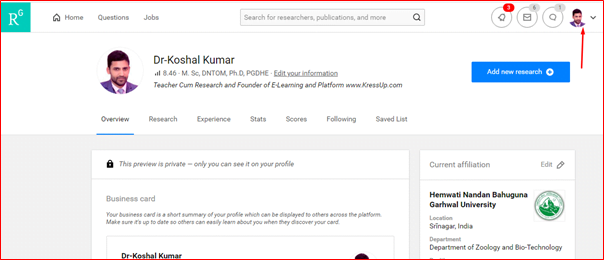
Author should need to join some creamy social networking sites such as Academia, Research Gate, Google Scholar, orchid IDs, and LinkedIn and also create an account on these platforms to get update, connection with the different scientific community and also grasp benefits in your research.

Read: How to Get a Free Research Gate Account Without an Institutional Email Address

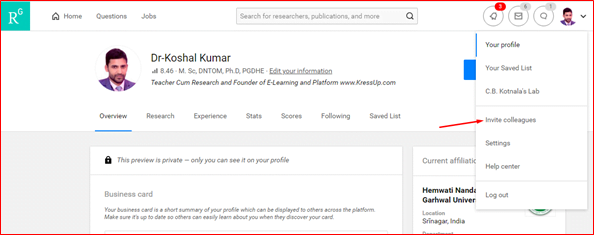
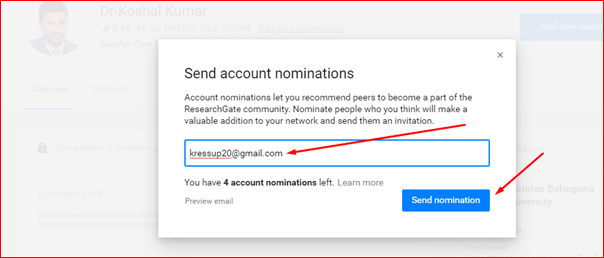
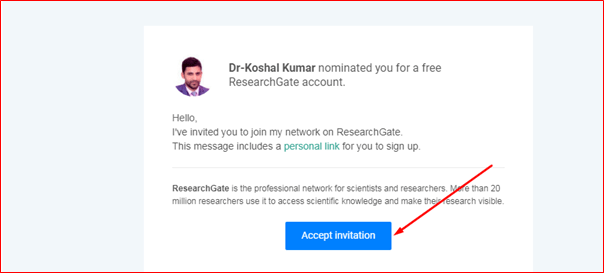
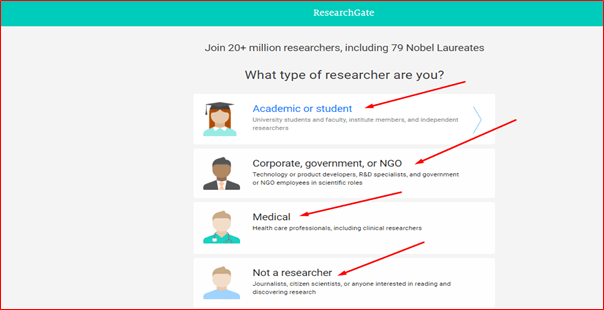
How To Create A ResearchGate Account And Why It’s Important

4. Upload your research on social platforms.

Once published immediately upload your research article on-site on social platforms such as Research gate, Facebook, Twitter, LinkedIn, etc. where you can make your research attract an audience from different backgrounds.

5. Publishing lots of papers

If you have a good amount of data and if you are planning to publish your data, then make a schedule. Try to plan your writing and publish your research articles on a regular basis and focus on depositing your papers in open access repositories.

For example, we can see that in 2020, author A published more than 20 papers and found that articles published in high impact factor journals increased the probability of getting cited an extra number of times as compared to author B, who published only 5 papers in 2020.

6. Keywords and phrases in your research paper

Make a list of some keywords relevant to your study and repeat them on the abstract page of your paper.

Since search engines and citation trackers search the website of your article, the normal repetition of keywords increases the chance of your people being retrieved more and using keywords is a vital part of abstract writing.

So the keywords are the search terms used in any research paper that is specific and that reflect what is essential about your paper number.

7. Publish more review articles comparing your research articles.

The review paper is more likely to be cited more than an original research paper and other articles.

You can publish your review articles by collecting the published research articles and these articles you are reading, looking for some new input from your site planning your experiment by referring to these research articles.

Draft a review paper by giving your own input like the need to be very specific with your keywords and when you are publishing your review article.

Focus to it that you have a good amount of references cited in your review articles that can promote your research work and generate citation in future.

8. Do collaborative work with different scientific communities.

If you are working on a particular area, you can find other different research groups that are also involved in working on similar or different aspects related to your field.

Try to communicate with them, try to collaborate with them, try to request from them that you will share your authorship with them and ask them whether they can accommodate you as a co-author and like this you can improve your research paper circulation at the same time it also increases your citation scope.

Study says that the authors who are often involved in international collaboration receive more citation numbers.

9. Work with research journals

Work with the journals where you can act as a reviewer and upgrading your scientific knowledge in a particular field.

Imagine you are reviewing a paper related to your field and if you are reading that paper, reviewing that paper and see any lacunae in that paper and think that this research gap in the paper can be addressed by your research articles and try to fill this research gap or  lacuna by referring your research article

10. Target journals for publication

Every researcher wishes to submit the research findings in UGC-CARE, SCI, Scopus index, Elsevier’s and PubMed, etc. reputed Journals and ignore the journal which is non-Scopus or new journals or journals offering a free publication.

My dear learners, I would like to add a note that if you try to target these journals like once a year and you have any research paper with a mini-review then you try to focus on journals which are new, offering free publications  etc.

You get more advertisement in your research as these new journals are trying to promote their published research articles and simultaneously your research or review article published in these journals indirectly will be promoted

The free online availability increases a people’s impact number and freely accessible articles increased citations by 50% or more number.

11. Try to target special issues of research journals.

In a special issue of every journal, there are lots of calls for paper every year and on the yearly basis for contributing research article in special issues which are published by any publishing agency and different scientific publishes.

These special issues are authorized to get more contributions and if your research article fits into this special issues then you get wide publicity which attracts more audience and get citations.

12. Try to attend more conferences.

In the conferences you tend to meet with different scientific audience and scientific communities who are working on different aspects of science or different fields are simply related to your research and on this gathering.

You can try to share your knowledge, try to get updated and try to participate by presenting your research paper or findings where you can get more quotes and will be converted in citation near future.

13.  Take expert advice

Expert advice is very valuable, highly valuable no matter who you are, the expert advice is highly essential even the principal researchers who have flourished in the scientific field one time or the other during the scientific journey they have done the same expert advice.

You can also talk to your supervisors, seniors’ colleagues or your competitors to get benefitted.

Wrappig Up

This is all about citation and how to increase citation using tips and tricks and hope tips help you in the promotion of your published research work and gaining more citation to meet your academic goal, and get success in life,

KressUp is an academic cum research platform, which help you in your carrier advancement by brings new articles from time to time, stay connected.

If this is your first time here at this blog, this blog is to develop your academic skills and research. Please share and subscribe to our blog so that it can reach all people in need, and for more E-content and research support, you can find it on our website or you can also write us an email for a free consultation.

If You find this article usefull, dont forget to share!

Related Articles:

Genral FAQ Related to Citation

Q 1. What is a Citation?

It is a method used to refer to another source we used in your research or manuscript or the way you tell your readers that certain things in your work come from another source.

Q 2. How to increase paper citation

Promote your publication among other researchers, motivate them to follow or pass on your research work and in this way get a reference of your work that leads to increase your citation points and improve your author’s matrix.

Q 3. Tips to increase citation Score

After publication promote your research paper, join social media sites, add the right keyword to the research, publish your work regularly, improve the author’s platform etc.

Q 4. How do I find citation of a paper?

By using indexed search on the Web of Science, Google expert and other search engine helps you identify your citation, for example you can search using the author’s name and year of publication.

Q 5. Citation Booster

Promote, promote and promote your research work is only the citation booster

Coronavirus Lockdown A Vaccine For Ecosystem Restoration

The impact of coronavirus lockdown on the restoration of the Environment and Global Warming issue a step toward the “Ecosystem Restoration” which is the theme of World Environment Day 20121.

These Environmental issues include a wide range of pollutants, including ozone, water, industry, noise pollution, increase day by day and in this race man versus wildlife conflict is also considered. But it has been noticed and observed globally that during this lockdown period our environment diversity including flora and fauna get restored better than the previous one. Watch this video for better understanding

Coronavirus: Good for the environment

It has been accepted that this coronavirus Lockdown influence to revive the status of our mother earth and it is not worng to say that this coronavirus act as environmental vaccination to cope up with these global anthropogenic activities and human wildlife conflict, since years back with Zero restoration after spending billions dollar economy on the conservation and management of environment and forests.

But it was noticed and observed that how this Coronavirus Lockdown and previous one also shows postive impact on various environmental parameters, and which was not seen in any scientific studies till now. This lockdown restoration process is a hot topic of research and discussion globally that helps to find the solution of Earth ecosystem degradation which will be for the wellbeing of our mother earth.

Coronavirus Lockdown Supports the Environment To Bounce Back, Stay Safe and Save The Mother Earth

Watch this video analysis to see the postive lockdown impact on this planet

Positive Impact of Coronavirus Lockdown

“Although the human develops coronavirus vaccine, however this coronavirus itself is an environmental vaccine and we humans are viruses”

There is a chance that once the lockdown period has passed the environment pollution levels may return at a faster rate so the human effort to save the environment can have a lasting impact.

Thus, we can conclude that if we make the weather deterioration or worse than Mother Nature is trying to bounce back, and we should understand what the global climate can expect.

This is all about this article and hopes these analyses open the shutter of your mind and you can think about the health and wealth of Our Planet Mother Earth, KRS is an academic cum research platform, which help you in your carrier advancement by brings new articles from time to time, stay connected.

If this is your first time here on this blog helping you grow your academic and research carrier please share and subscribe to our website, so that it can reach all people in need, and for more E-content, for research support, you can find it on our website or you can also write us at info@kressup.com for a free consultation

My Suggestion: An annual 2-3 weeks lockdown, which not only improves the Global Environment Status but also saves Billions of Dollars Economy which is used every year to protect this Global Environment Prestige.